

events

New Haven Independent: Olin Keeps Testing Six Lakes — And Community Patience

Six Lakes organizer Justin Farmer: “The last time Olin got something in on time was before I existed.” Credit: Brian Slattery photo

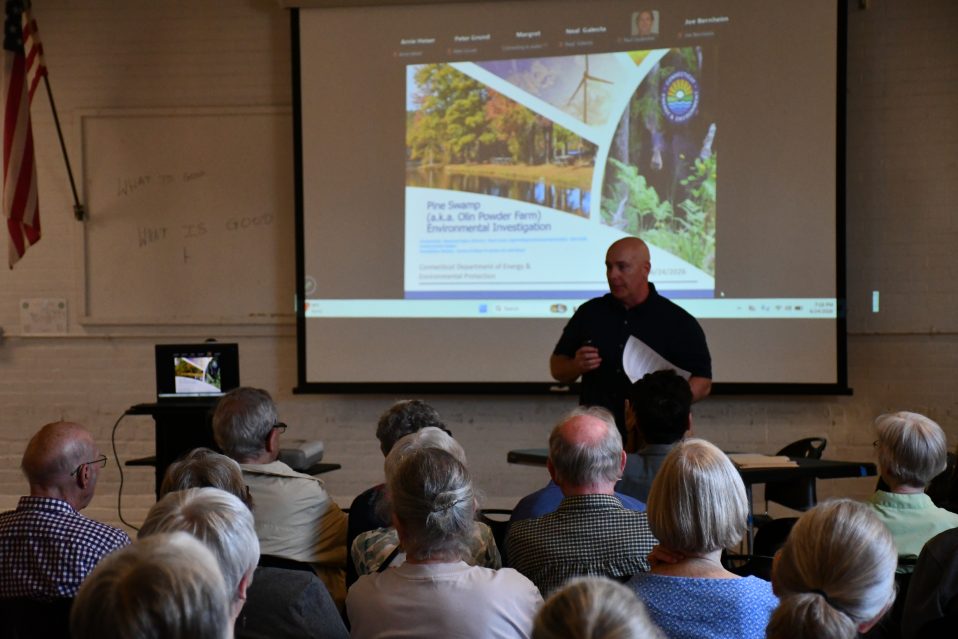
John Duff, an environmental analyst at the state’s Department of Energy and Environmental Protection (DEEP), was rounding up his summary of the testing the Olin Corporation has so far conducted at the Six Lakes site in southern Hamden, to figure out how polluted it is in order to make a plan to remediate it.

It was part of DEEP’s annual community meeting, held at the Keefe Community Center on Pine Street in Hamden Wednesday evening, to inform the public regarding the status of the cleanup. Several dozen people attended.

“A very large quantity of data has been obtained over the past few years,” Duff said. But “you got to understand that this is a 102-acre property, and additional characterization is still required for both known and potential areas of concern.”

“Too slow,” a community member interjected. “It’s been 40 years.”

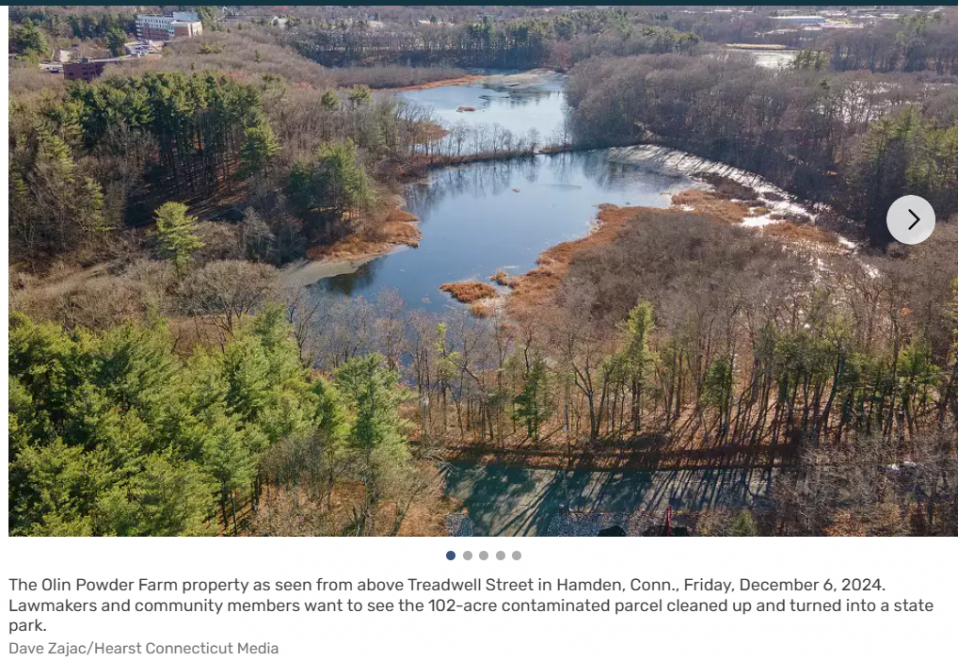
That was the tone of the meeting about Six Lakes, a.k.a. the Powder Farm, a.k.a the Pine Swamp, a 102.5-acre parcel of land and water — bordered by Treadwell Street, Leeder Hill Drive, Putnam Avenue, and the Farmington Canal Trail — with a complex history (read about that here).
Read the full article here

Read more

New Haven Register: Could a contaminated, 102-acre property in southern Hamden become Connecticut’s next state park?

HAMDEN — In 1969, local conservationists first approached the owner of a 102.5-acre contaminated property in the southern part of town about cleaning it up and turning it into a state park.

More than half a century later, Six Lakes is still heavily polluted and closed to the public, despite growing calls for remediation and a strong desire from the state to preserve more undeveloped land as open space.

Read the article here.

Read more

New Haven Independent: Six Lakes Coalition Tours the Perimeter

On Sunday afternoon a crowd of nearly 100 people, from citizens to activists to numerous elected officials, converged on the parking lot of ACES Whitney High School North on Leeder Hill Drive in Hamden. The purpose of the visit was the land behind the high school — 102 acres of forest, lakes, and wetlands, closed off from the public for decades because of its use as a place to test firearms and munitions and dispose of toxic waste…

Click here to read the full article.

Read more